
Understanding Diagnostic Expectations: From Theory to Household Beliefs
Published:
Rational expectations (RE) posit that agents efficiently use available information to forecast economic variables, implying unpredictable forecast errors. Coibion and Gorodnichenko (2015) propose an empirical test (CG test) that regresses forecast errors on forecast revisions. For an outcome realized in period t+h, the forecast error compares the realization with the forecast made at t, while the revision compares forecasts made at t and t-1 for the same outcome. Under RE, the coefficient is zero, while positive (negative) values indicate underreaction (overreaction) to news. Bordalo et al. (2020) find that individual professional forecasters typically overreact, while consensus forecasts underreact relative to full-information RE. They explain individual overreaction through diagnostic expectations (DE).

From Rational Expectations to Diagnostic Expectations
The concept of DE did not originate in economics, but in psychology. Kahneman and Tversky (1972) developed the idea of representativeness, suggesting that individuals tend to assign greater probability to outcomes that are characteristic of a given group or situation. In other words, when an outcome is relatively more common in one group than in a reference population, individuals may exaggerate its likelihood, even if the outcome remains relatively uncommon in absolute terms. This leads to a distortion in perceived probabilities.
For example, Ireland has one of the largest shares of red-haired people in its population, at approximately 10%, while the worldwide average is only 1%–2%. Because red hair is much more common in Ireland than elsewhere, people may associate this characteristic with the Irish population. Consequently, they may overestimate the probability that a randomly selected person from Ireland has red hair, believing that the share is much higher than its actual value of 10%.
Applications in Macroeconomics and Finance
Many macroeconomic and financial phenomena can be explained by DE. Bordalo et al. (2018) develop a model of credit cycles in which investors overreact to economic news, generating excessive volatility in credit spreads and predictable reversals. In particular, positive economic news leads investors to become excessively optimistic, underestimate future risks, and expand credit, especially to riskier borrowers. Conversely, when economic conditions deteriorate, expectations reverse, increasing perceived risk and credit spreads and contributing to a contraction in credit.
Extending DE to the stock market, Bordalo et al. (2019) explain why stocks with the most optimistic analysts’ long-term earnings growth forecasts subsequently earn lower returns than stocks with the most pessimistic forecasts. They show that analysts extrapolate observed earnings growth into future profitability but overreact to news by exaggerating the probability of favorable or unfavorable future outcomes. Consequently, excessive optimism leads to overvaluation and lower subsequent stock returns as expectations adjust toward fundamentals.
Several empirical consumption patterns are difficult to reconcile with the rational-expectations permanent-income hypothesis (RE-PIH) but can be explained by adding diagnostic expectations. Yin et al. (2023) analyze why positive income shocks increase current consumption but lead to a subsequent decline in consumption. Under the RE-PIH, consumption changes respond only to unanticipated changes in lifetime resources, making these predictable reversals difficult to explain. By contrast, DE cause households to overreact to positive income shocks by forming excessively optimistic expectations about future income, leading them to increase current consumption beyond what fundamentals justify. As these expectations adjust, consumption declines.
Diagnostic Expectations and Household Beliefs
When analyzing household expectations, the literature has presented evidence consistent with DE, although not directly attributable to it. D’Acunto et al. (2023) observe a persistent upward bias in household inflation expectations, highlighting the roles of daily price signals, lifetime experiences, and cognition. However, an upward forecast bias is not sufficient evidence of DE, which predicts excessive responses to news.
Malmendier and Nagel (2016) propose experience-based learning to explain inflation expectations, showing that younger individuals respond more strongly to recent inflation because it represents a larger share of their lifetime experiences. While experience-based learning emphasizes the weight assigned to historical observations, DE emphasizes the exaggeration of changes in the perceived probabilities of future outcomes following new information.
Similarly, D’Acunto et al. (2021) show that inflation expectations depend more strongly on the shopping frequency of certain goods than on their expenditure weights. Although households may perceive frequently purchased goods as more representative, this pattern could reflect selective attention rather than DE.
Smooth Diagnostic Expectations and Uncertainty
Recently, Bianchi et al. (2026) extended the theory of DE by introducing smooth diagnostic expectations, in which the degree of overreaction depends on uncertainty. The intuition is that lower uncertainty narrows the range of plausible outcomes, leaving less room for representativeness to distort beliefs. Conversely, higher uncertainty allows individuals to exaggerate the probabilities of outcomes that become more representative following new information.
Using data from the Survey of Professional Forecasters (SPF), the authors find that overreaction, measured through the CG test, intensifies during periods of higher macroeconomic uncertainty for most variables. Motivated by this empirical evidence, they incorporate smooth DE into a real business cycle (RBC) model to examine how belief distortions interact with uncertainty to affect aggregate fluctuations. The model shows that this mechanism helps explain business-cycle asymmetries and countercyclical volatility.
Kang (2024) applies smooth DE to examine how the Federal Reserve’s adoption of an explicit inflation target in 2012 may have reduced overreaction in the updating of inflation expectations. The announcement provided a signal about the trend component of inflation, potentially reducing uncertainty and limiting belief distortions. The author suggests that this mechanism may have contributed to the stabilization of realized inflation.
Preliminary Evidence from UK Households
I am curious about the evidence for smooth DE beyond professional forecasters. What about households, which have different incentives and mental models of economic dynamics? Although household-expectation surveys are available, they often lack repeated forecasts for the same variable and target period, which are necessary for the CG test. One alternative, although imperfect, is to construct homogeneous cohorts based on observable characteristics to approximate individual belief updating while minimizing the aggregation effects associated with consensus forecasts. This approach could provide preliminary evidence of smooth DE among households until more detailed panel data become available.
So, I got to work! I use data from the Bank of England Inflation Attitudes Survey (BEIAS) to construct homogeneous pseudo-cohorts based on age, gender, and housing tenure. I approximate individual belief updating by comparing the two-year-ahead inflation forecast made in quarter t-4 with the one-year-ahead forecast made in quarter t, both referring to inflation from t to t+4. Following Bianchi et al. (2026), I extend the CG test to incorporate uncertainty.
The baseline results indicate underreaction, suggesting sticky expectations rather than DE. However, higher uncertainty dampens underreaction, consistent with rational inattention (RI), as uncertainty may increase incentives to acquire information. These results are preliminary and intended only to motivate the idea. In sum, smooth DE and RI may offer competing explanations for how uncertainty affects belief updating, presenting an interesting puzzle for further research.
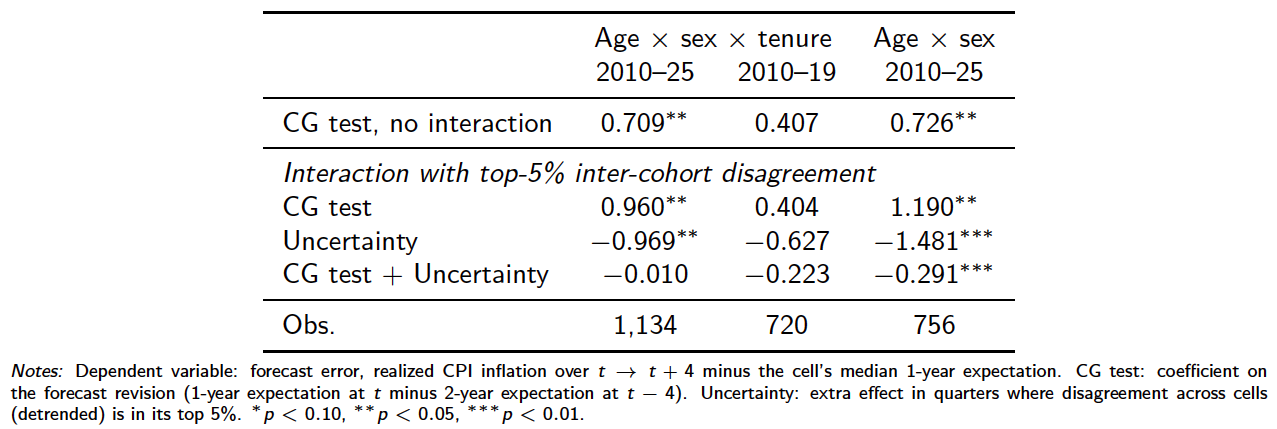
Figure 1. Smooth diagnostic expectations test for households.
Directions for Future Research
Additionally, large language model (LLM) techniques could help identify the mechanisms underlying household belief formation. A panel survey could track expectation revisions over time, using open-ended questions and LLMs to classify households’ reasoning. Randomized information treatments could test DE by presenting identical inflation data while varying the emphasis on representative outcomes. Comparing forecast revisions across treatments would help identify diagnostic overreaction, while varying information-acquisition costs could help distinguish DE from RI.
References
Bianchi, F., Ilut, C., & Saijo, H. (2026). Smooth diagnostic expectations. Review of Economic Studies, rdag077. Read paper.
Bordalo, P., Gennaioli, N., Ma, Y., & Shleifer, A. (2020). Overreaction in macroeconomic expectations. American Economic Review, 110(9), 2748–2782. Read paper.
Bordalo, P., Gennaioli, N., Porta, R. L., & Shleifer, A. (2019). Diagnostic expectations and stock returns. The Journal of Finance, 74(6), 2839–2874. Read paper.
Bordalo, P., Gennaioli, N., & Shleifer, A. (2018). Diagnostic expectations and credit cycles. The Journal of Finance, 73(1), 199–227. Read paper.
Coibion, O., & Gorodnichenko, Y. (2015). Information rigidity and the expectations formation process: A simple framework and new facts. American Economic Review, 105(8), 2644–2678. Read paper.
D'Acunto, F., Malmendier, U., Ospina, J., & Weber, M. (2021). Exposure to grocery prices and inflation expectations. Journal of Political Economy, 129(5), 1615–1639. Read paper.
D'Acunto, F., Malmendier, U., & Weber, M. (2023). What do the data tell us about inflation expectations? In Handbook of Economic Expectations (pp. 133–161). Academic Press. Read chapter.
Kahneman, D., & Tversky, A. (1972). Subjective probability: A judgment of representativeness. Cognitive Psychology, 3(3), 430–454. Read paper.
Kang, N. (2024). The Fed explicitly speaks: Numerical inflation targeting and smooth diagnostic expectations. Read paper.
Malmendier, U., & Nagel, S. (2016). Learning from inflation experiences. The Quarterly Journal of Economics, 131(1), 53–87. Read paper.
Yin, P., Luo, Y., & Guo, J. (2023). Diagnostic expectations and consumption dynamics. Available at SSRN 5173669. Read paper.