
Why 5% Isn’t Always 5%: The Fisher Equation and Money Illusion
Published:
Imagine you have $1,000 available to save. You decide to deposit the money in a savings account that pays 5% annual interest. In nominal terms, you will have $1,050 at the end of one year. However, to determine the true value of your investment in terms of purchasing power, you must take inflation into account. Suppose inflation is 2% over the course of the year. In that case, the real value of your investment after one year is approximately $1,030. This idea gives rise to the concept of the real interest rate, which is approximately equal to the nominal interest rate minus the inflation rate (Fisher equation). In this example, the real interest rate is 3%.
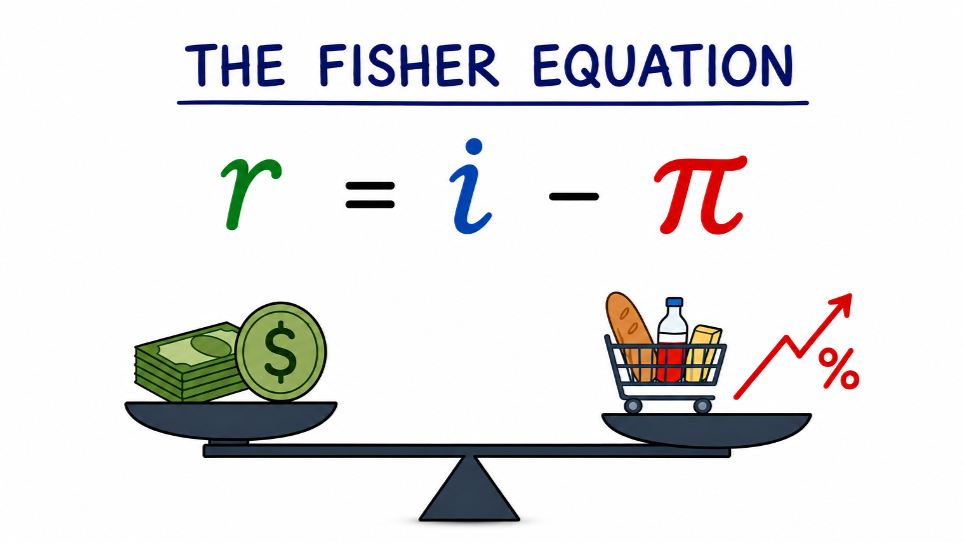
In macroeconomic models, consumers adjust their consumption in response to changes in the real interest rate. This is known as the intertemporal substitution channel, in which higher real interest rates create an incentive to save more today and postpone consumption to the future. Consistent with this mechanism, survey data show that households report reducing their spending, particularly on durable goods, when interest rates increase (Grigoli et al. (2026)). However, economists have asked whether households actually understand and make decisions based on real interest rates. Do they take purchasing power into account when evaluating the returns to saving, or do they focus only on nominal interest rates? Recent research provides evidence on this question.
The study by Bosch-Rosa et al. (2026) uses a within-subject survey experiment conducted on a representative sample of the German population. Participants were presented with hypothetical scenarios in which the real interest rate increased by 5 percentage points, either through an increase in the nominal interest rate or through an equivalent decline in inflation. Respondents were then asked how they would adjust their consumption in each scenario. If households fully understand the concept of the real interest rate, their consumption responses should be the same in both cases. Surprisingly (or perhaps not), respondents reported larger reductions in consumption, higher saving, and lower borrowing when nominal interest rates increased, while adjusting these margins much less when inflation declined. One mechanism that partially explains this asymmetry is the difference in perceived wealth effects across the two scenarios. In a nutshell, households appear to internalize the consequences of changes in nominal interest rates more readily than those of disinflation.
Other studies have examined whether households misperceive the erosion of the purchasing power of money over time. This phenomenon is known as money illusion, in which consumers think primarily in nominal rather than real terms. Results from a survey experiment conducted in Japan show that people base their decisions on nominal interest rates rather than real interest rates, consistent with the findings of the previous study (Niizeki, 2025). Moreover, Niizeki (2025) investigates education as a potential mechanism but finds no significant differences in the degree of money illusion between more and less educated individuals. In contrast, Darriet et al. (2020) examine the roles of financial knowledge and numeracy. They find that individuals with greater financial knowledge are less susceptible to money illusion, whereas numeracy has no significant effect.
From a different perspective, Majumder et al. (2024) examine not only the extent to which people are affected by money illusion, but also the extent to which they believe others are affected by it. In the presence of inflation, they find that individuals believe they are less likely to buy and equally likely to sell than others when facing a higher nominal price with no change in the real price. Moreover, when asked directly, participants report placing greater importance on the real value of money than on its nominal value, relative to others. This suggests that people tend to perceive themselves as being less susceptible to money illusion than others.
Focusing on investors’ behavior, Lioui and Tarelli (2023) investigate why the market demand for Treasury Inflation-Protected Securities (TIPS) remains relatively low, considering money illusion as a potential explanation. They estimate that investors incur a certainty-equivalent loss of 1.6% per year by not investing in inflation-indexed bonds. However, investors who suffer from money illusion perceive this loss to be much smaller, only 0.5% per year.
The presence of money illusion may depend on which component of the household balance sheet is affected (assets or debt). In this context, Schnorpfeil et al. (2023) find that, although households are generally well informed about prevailing inflation and are concerned about its impact on their wealth, and many understand that inflation erodes the real value of nominal assets, most are unaware that inflation also erodes the real value of nominal debt. When households receive information about the debt-erosion channel, they revise upward their beliefs about the value of nominal debt and, consequently, about their own real net wealth. These belief revisions causally affect both actual consumption and hypothetical borrowing decisions. In a nutshell, real wealth mediates the effect of inflation on consumption once households become aware of the wealth effects of inflation.
I have the perception that the presence (or at least the intensity) of money illusion is state dependent. In particular, households may become more aware of the erosion of the nominal value of money during periods of high inflation. For example, Pfäuti (2026) finds evidence of an inflation attention threshold of approximately 4% in the United States, at which households experience a discrete increase in their attention to inflation. Korenok et al. (2026) confirm this finding by estimating similar attention thresholds for most countries, typically between 2% and 4% inflation.
When considering cross-sectional differences in money illusion, a promising avenue for research is to examine its relationship with attention to inflation. For instance, individuals who have experienced episodes of high inflation in the past (Braggion et al., 2024) may be less susceptible to money illusion. Similarly, UK households with greater exposure to financial assets and liabilities pay more attention to inflation (Delgado, 2026), suggesting that they may be less prone to money illusion.
References
Bosch-Rosa, C., Heinemann, F., Massenot, B., & Meissner, T. (2026). Different Consumption Responses to Equivalent Changes in the Real Interest Rate.
Braggion, F., von Meyerinck, F., Schaub, N., & Weber, M. (2024). The long-term effects of inflation on inflation expectations. NBER Working Paper No. 32160. National Bureau of Economic Research.
Darriet, E., Guille, M., Vergnaud, J. C., & Shimizu, M. (2020). Money illusion, financial literacy and numeracy: Experimental evidence. Journal of Economic Psychology, 76, 102211.
Delgado, C. (2026). Household (in)attention to inflation and balance-sheet position: Macroeconomic implications. Working paper, Texas A&M University.
Grigoli, F., Sandri, D., Gorodnichenko, Y., & Coibion, O. (2026). Monetary policy according to households: perceptions, reactions and channels. NBER Working Paper No. 35127.
Korenok, O., Munro, D., & Chen, J. (2026). Inflation and attention thresholds. Review of Economics and Statistics, 1–9.
Lioui, A., & Tarelli, A. (2023). Money illusion and TIPS demand. Journal of Money, Credit and Banking, 55(1), 171–214.
Majumder, R., Ziano, I., & Mai, R. (2024). Money illusion for others. Proceedings of the European Marketing Academy, 52, 118995.
Niizeki, T. (2025). Money illusion of interest rates and household decision-making. Economics Bulletin, 45(1), 111–117.
Pfäuti, O. (2026). The inflation attention threshold and inflation surges. Working paper, The University of Texas at Austin.
Schnorpfeil, P., Weber, M., & Hackethal, A. (2023). Households' response to the wealth effects of inflation. NBER Working Paper No. 31672.