
From Uncertainty to Expectations: How Do Households Think About Inflation?
Published:
Nowadays, uncertainty is no longer an isolated or transitory phenomenon. Instead, it has become a persistent feature of the economy, especially during the 2020s. The Economic Policy Uncertainty (EPU) index (Baker et al., 2016) exhibits a clear upward trend (see Figure 1), and measures of macroeconomic uncertainty from Jurado et al. (2015) display record-breaking spikes in recent years. Empirical evidence shows that uncertainty shocks affect realized economic outcomes and are important drivers of macroeconomic fluctuations (Caldara et al., 2016). However, because agents form expectations about future variables when making decisions, uncertainty may also play a crucial role in shaping their forecasts.
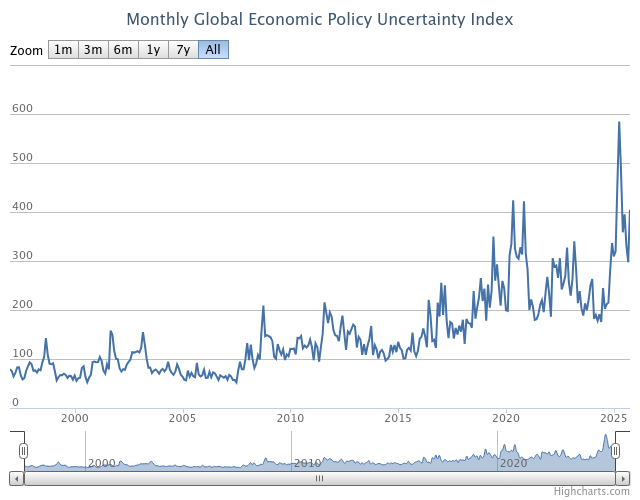
Figure 1. Monthly Global Economic Policy Uncertainty Index.
Against this backdrop, I am interested in how rising uncertainty affects the expectations that households form about key macroeconomic variables. Among the set of variables that households forecast for decision making, this blog focuses on inflation. The ability to forecast inflation is important for individuals’ financial well-being (Bruine de Bruin et al., 2010). According to the intertemporal substitution channel, households choose the timing of real consumption based on fluctuations in the real interest rate, that is, the difference between the nominal interest rate and expected inflation. When inflation expectations rise (ceteris paribus), the real interest rate declines, or is at least perceived to decline, leading households to prefer higher current consumption due to lower borrowing costs. This mechanism has been empirically documented for durable goods consumption (Coibion et al., 2022). Complementarily, individuals who anticipate rising house prices are more likely to increase their spending, particularly those facing borrowing constraints (Qian, 2023).
Households do not form inflation expectations uniformly. These expectations are biased upward, dispersed across individuals according to demographic characteristics, and volatile over time (D’Acunto et al. (2023); Doh et al. (2025)). In particular, low-income and less-educated individuals exhibit larger biases in their inflation expectations (Reid et al., 2021). Although these biases are typically defined relative to the national average, Kaplan and Schulhofer-Wohl (2017) show that lower-income U.S. households indeed experience higher inflation in their consumption bundles.
The preceding evidence motivates the question of how uncertainty influences inflation expectations. I distinguish two potential dimensions of this impact. The first concerns the dispersion, or cross-sectional distribution, of inflation expectations. When uncertainty increases, households may receive noisier signals about the evolution of the price level, as the variance of variables in their information set rises, leading to a wider distribution of expectations. Moreover, because collecting and processing information becomes more costly during periods of heightened uncertainty, the influence of individual signals may become more pronounced.
There is empirical evidence on the effect of EPU on inflation uncertainty. Binder (2017) measures inflation uncertainty using the proportion of round-number responses in surveys eliciting household inflation expectations. The author shows that EPU is more strongly correlated with short-run inflation uncertainty than with long-run inflation uncertainty. By contrast, the relationship is reversed for monetary policy uncertainty (MPU). The explanation for this latter case is likely related to the role of central banks in anchoring inflation expectations to specific targets. When examining differences across demographic groups, the impact of EPU is stronger for higher-income and more-educated individuals. This finding is consistent with their higher levels of financial literacy (Lusardi, 2008) and greater attentiveness to political news (Jones, 2023).
Beyond dispersion, uncertainty may also affect inflation expectations at the aggregate level. This second dimension concerns the impact of uncertainty on the average level of inflation expectations. What might be the expected sign of this effect? One intuition rests on how households categorize both inflation and uncertainty as “good” or “bad” outcomes. Inflation may be perceived as unfavorable due to its erosion of purchasing power, while uncertainty may be viewed negatively because of the potential instability it implies for households’ labor income and financial positions. If both are labeled as adverse outcomes, an increase in uncertainty could raise inflation expectations. This mechanism can be associated with a cognitive bias known as the horn effect (or negative halo), whereby a negative assessment of one attribute of the economy leads agents to infer negative outcomes in other macroeconomic variables, even in the absence of a causal link (Forgas and Laham, 2016). Consistent with this intuition, individuals tend to fear inflation more than deflation (DeLong and Sims, 1999).
This intuition, however, need not apply in all circumstances. If a specific situation generating higher uncertainty is associated with deflationary pressures, the implications for inflation expectations may differ. This was the case during the Great Depression, when a one-standard-deviation increase in uncertainty was shown to reduce GDP and the price level (Mathy, 2020). In this vein, Leduc and Liu (2016) argue that uncertainty shocks resemble aggregate demand shocks, increasing unemployment and lowering inflation.
These mechanisms may not operate uniformly across the population. When considering potential differences across demographic groups, individuals with lower financial literacy are likely more prone to form forecasts based on a horn effect. This interpretation is consistent with evidence showing that individuals pay attention to news reports, such as professional forecasts, only occasionally, leading to stickiness in aggregate expectations (Carroll, 2003).
Another behavioral channel through which uncertainty may affect inflation expectations is loss aversion. As noted earlier, inflation expectations are upward biased. From an econometric perspective, such expectations would be deemed irrational if agents are assumed to have symmetric loss functions. However, when loss functions are asymmetric, rationality can be restored. In particular, when individuals are averse to “bad” outcomes, such as higher-than-expected inflation, they incorporate this loss aversion into their forecasts (Elliott et al., 2008). Consequently, when uncertainty increases, loss aversion may become more pronounced, leading agents to bias their inflation predictions upward.
In addition to these direct behavioral channels, uncertainty may influence inflation expectations through indirect macroeconomic mechanisms. Because inflation expectations depend in part on past realized inflation, the effect of uncertainty may operate through inflation itself. For instance, if uncertainty acts as a negative demand shock and inflation declines, households’ inflation expectations may also decrease, albeit with a delay.
In conclusion, analyzing the relationship between uncertainty and households’ expectations about macroeconomic outcomes is an important topic for further research. In particular, it would be novel to understand potential discrepancies in both magnitude and direction when comparing expectations with realized outcomes. While uncertainty clearly affects inflation, less is known about its influence on forecast revisions of inflation. Are such revisions driven by cognitive biases, such as the horn effect? Is there an overreaction rooted in loss aversion? Are these effects heterogeneous across population segments? What role do information acquisition and processing costs play in shaping this relationship? Addressing these questions could significantly improve our understanding of the implications for monetary policy, especially in an environment where elevated uncertainty has become a persistent feature of modern economies.
References
Baker, S. R., Bloom, N., & Davis, S. J. (2016). Measuring economic policy uncertainty. The Quarterly Journal of Economics, 131(4), 1593–1636.
Binder, C. C. (2017). Measuring uncertainty based on rounding: New method and application to inflation expectations. Journal of Monetary Economics, 90, 1–12.
Bruine de Bruin, W., Vanderklaauw, W., Downs, J. S., Fischhoff, B., Topa, G., & Armantier, O. (2010). Expectations of inflation: The role of demographic variables, expectation formation, and financial literacy. Journal of Consumer Affairs, 44(2), 381–402.
Caldara, D., Fuentes-Albero, C., Gilchrist, S., & Zakrajšek, E. (2016). The macroeconomic impact of financial and uncertainty shocks. European Economic Review, 88, 185–207.
Carroll, C. D. (2003). Macroeconomic expectations of households and professional forecasters. The Quarterly Journal of Economics, 118(1), 269–298.
Coibion, O., Gorodnichenko, Y., & Weber, M. (2022). Monetary policy communications and their effects on household inflation expectations. Journal of Political Economy, 130(6), 1537–1584.
D'Acunto, F., Malmendier, U., & Weber, M. (2023). What do the data tell us about inflation expectations? In Handbook of Economic Expectations, 133–161.
DeLong, J. B., & Sims, C. A. (1999). Should we fear deflation? Brookings Papers on Economic Activity, 1999(1), 225–252.
Doh, T., Lee, J. H., & Park, W. Y. (2025). Heterogeneity in household inflation expectations and monetary policy. Journal of Financial Econometrics, 23(1), nbae034.
Elliott, G., Komunjer, I., & Timmermann, A. (2008). Biases in macroeconomic forecasts: Irrationality or asymmetric loss? Journal of the European Economic Association, 6(1), 122–157.
Forgas, J. P., & Laham, S. M. (2016). Halo effects. In Cognitive Illusions, 276–290.
Jones, J. M. (2023). U.S. attention to political news slips back to typical levels. Gallup.
Kaplan, G., & Schulhofer-Wohl, S. (2017). Inflation at the household level. Journal of Monetary Economics, 91, 19–38.
Leduc, S., & Liu, Z. (2016). Uncertainty shocks are aggregate demand shocks. Journal of Monetary Economics, 82, 20–35.
Jurado, K., Ludvigson, S. C., & Ng, S. (2015). Measuring uncertainty. American Economic Review, 105(3), 1177–1216.
Lusardi, A. (2008). Household saving behavior: The role of financial literacy, information, and financial education programs. National Bureau of Economic Research Working Paper.
Mathy, G. P. (2020). How much did uncertainty shocks matter in the Great Depression? Cliometrica, 14(2), 283–323.
Qian, W. (2023). House price expectations and household consumption. Journal of Economic Dynamics and Control, 151, 104652.
Reid, M., Siklos, P., & Du Plessis, S. (2021). What drives household inflation expectations in South Africa? Demographics and anchoring under inflation targeting. Economic Systems, 45(3), 100878.