
Does (and how does) financial literacy shape monetary policy transmission?
Published:
Central banks not only stabilize inflation by setting nominal interest rates, but also by communicating their policies effectively to anchor individuals’ expectations. However, although policymakers convey their decisions to agents, not all individuals receive or process this information in a complete and rational way. Effective transmission requires that individuals possess a basic understanding of financial concepts, particularly inflation, interest rates, and the functioning of investment and debt instruments. In other words, this relates to the concept of financial literacy.
What is financial literacy? It is the degree of knowledge of four essential concepts in financial decision-making: (1) knowledge of interest rates (numeracy), (2) interest compounding, (3) inflation, and (4) risk diversification. The S&P Global FinLit Survey elicits these aspects from a representative sample of individuals across countries. A person is defined as financially literate when he or she correctly answers at least three out of the four financial concepts described above (Klapper et al., 2015).
Promoting financial literacy among households is relevant for increasing attention to and monitoring of key economic variables such as interest rates, unemployment, and inflation. This knowledge allows households to make more informed consumption, debt, and investment decisions. Importantly, financial education also has macroeconomic implications, particularly for the transmission of monetary policy. Niţoi and Pochea (2024) find that financially literate individuals are more likely to trust central banks, while Coibion et al. (2022) emphasize the role of cognitive ability in shaping how individuals process monetary policy signals.
These findings suggest that improving numeracy and financial knowledge may enhance expectation formation and contribute to more effective monetary policy transmission. Unfortunately, there is evidence of persistent gaps in this area. Lusardi and Streeter (2023) show that mastery of fundamental financial concepts remains low in the United States, particularly among younger individuals, those with lower levels of education, women, and the non-employed.
Standard DSGE models assume that agents are fully financially literate and attentive, and therefore make optimal decisions subject to their budget constraints. This assumption is counterfactual, as in reality there are substantial gaps in financial literacy. Consequently, this opens important avenues for future research. For example, I am interested in understanding why the direct monetary policy channel of intertemporal substitution appears to be weaker than other indirect transmission mechanisms. This channel posits that households adjust the timing of consumption in response to changes in the real interest rate, which requires forming inflation expectations and tracking nominal interest rates.
Gaps in financial literacy may partly explain the weak impact of intertemporal substitution, although further research is needed to confirm this hypothesis. Less financially educated individuals may exhibit inertia in saving or borrowing decisions when interest rates change, even in the absence of credit constraints. In other words, financial literacy may accelerate monetary policy transmission by lowering individuals’ costs of processing information about central bank decisions, thereby increasing their attentiveness to interest rate fluctuations. As a result, households would be more likely to adjust their saving and borrowing decisions quickly.
I provide another example. Cash flow is one of the indirect transmission mechanisms of monetary policy. It posits that fluctuations in interest rates affect debt service payments and, consequently, the cash flow available to households, thereby inducing changes in consumption. One of the most important debt components in terms of volume is mortgages. When mortgages carry variable interest rates, changes in interest payments are immediate. By contrast, when mortgages are set at fixed interest rates, households can benefit from monetary policy easing primarily through refinancing. However, not all households refinance their mortgages even when doing so would be optimal. This phenomenon is known as inaction.
Bialowolski et al. (2022) present evidence that higher financial literacy scores are associated with a greater likelihood of mortgage refinancing. Moreover, even when households decide to refinance, this does not necessarily imply that the new contract terms are optimal. In this vein, Agarwal et al. (2016) find that 57% of borrowers refinance suboptimally: most choose an inappropriate interest rate, while a smaller proportion wait too long to refinance. The likelihood of making smaller mistakes is higher among financially sophisticated borrowers.
Financial literacy plays an important role in shaping inflation expectations (Pedersen and Pérez, 2025). For instance, lower financial literacy is associated with higher inflation expectations and, consequently, weaker anchoring of expectations (Bruine de Bruin, 2010). Moreover, economic literacy enables individuals to form more accurate inflation forecasts. This improvement operates through information selection and processing channels, whereby more literate individuals are better able to identify relevant information and use it effectively, resulting in lower forecast errors. Although demographic differences in inflation expectations exist, these differences are largely driven by heterogeneity in economic literacy (Burke and Manz, 2014).
It is important to emphasize that financial literacy is distinct from the concept of financial inclusion. The latter refers to individuals’ access to and use of affordable financial products. However, financial inclusion does not necessarily translate into higher financial literacy. For instance, approximately one third of U.S. homeowners are not financially literate (see the figure below), even though the majority have accessed mortgage financing.
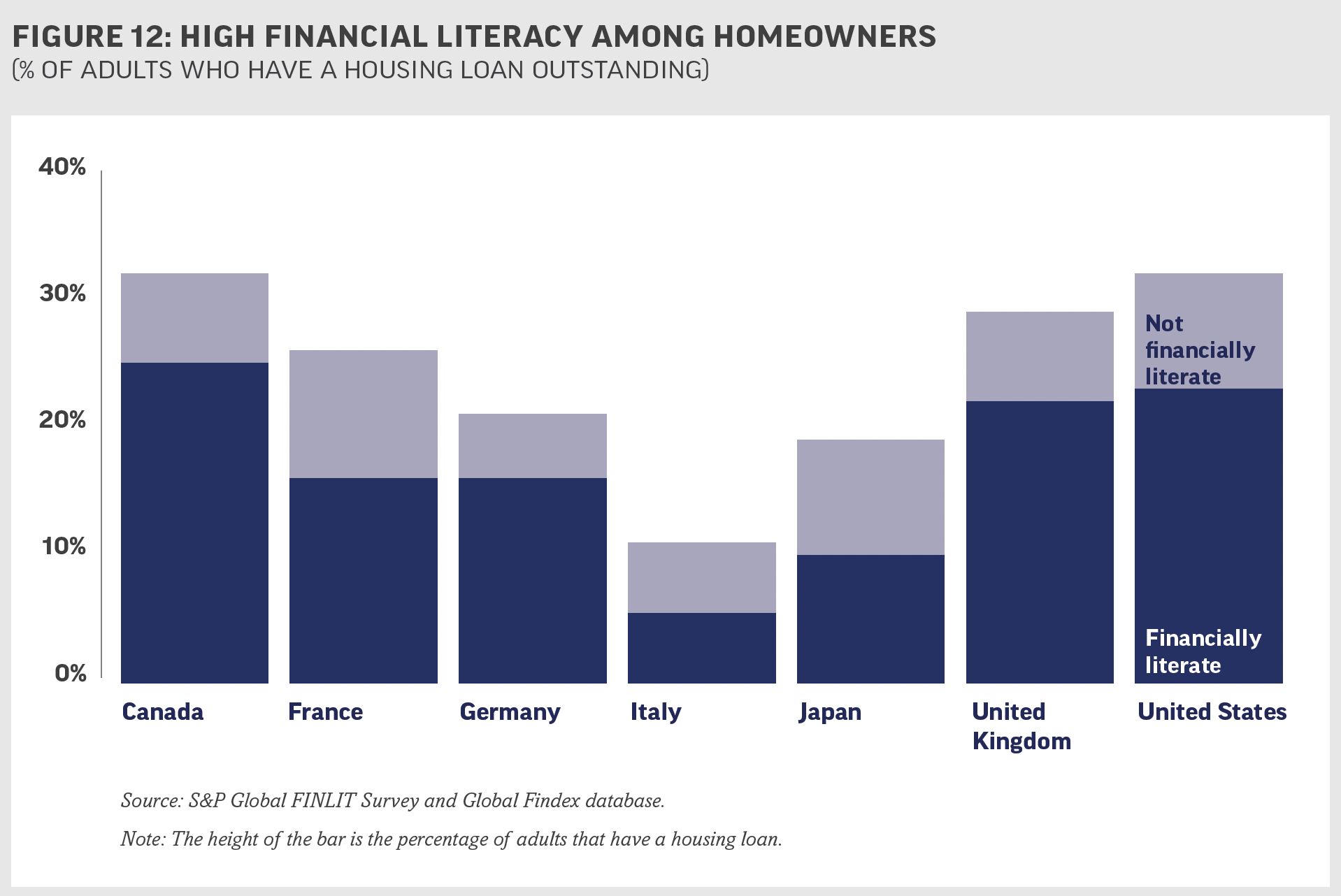
Figure 1. High financial literacy among homeowners. Source: S&P Global FINLIT Survey and Global Findex database.
Although there has been significant progress in incorporating rational inattention (and related mechanisms) into macroeconomic models of policy transmission, financial literacy may constitute an additional piece of the puzzle for understanding the magnitude and speed of monetary policy effects. Accounting for financial literacy could help explain differences in policy transmission within a country over time, as well as cross-country differences among economies with varying levels of financial literacy.
References
Agarwal, S., Rosen, R. J., & Yao, V. (2016). Why do borrowers make mortgage refinancing mistakes? Management Science, 62(12), 3494–3509.
Bialowolski, P., Cwynar, A., Xiao, J. J., & Weziak-Bialowolska, D. (2022). Consumer financial literacy and the efficiency of mortgage-related decisions: New evidence from the Panel Study of Income Dynamics. International Journal of Consumer Studies, 46(1), 88–101.
Bruine de Bruin, W., Vanderklaauw, W., Downs, J. S., Fischhoff, B., Topa, G., & Armantier, O. (2010). Expectations of inflation: The role of demographic variables, expectation formation, and financial literacy. Journal of Consumer Affairs, 44(2), 381–402.
Burke, M. A., & Manz, M. (2014). Economic literacy and inflation expectations: Evidence from a laboratory experiment. Journal of Money, Credit and Banking, 46(7), 1421–1456.
Coibion, O., Gorodnichenko, Y., & Weber, M. (2022). Monetary policy communications and their effects on household inflation expectations. Journal of Political Economy, 130(6), 1537–1584.
Klapper, L., Lusardi, A., & van Oudheusden, P. (2015). Financial literacy around the world: Insights from the Standard & Poor’s Ratings Services global financial literacy survey. World Bank.
Lusardi, A., & Streeter, J. L. (2023). Financial literacy and financial well-being: Evidence from the US. Journal of Financial Literacy and Wellbeing, 1(2), 169–198.
Niţoi, M., & Pochea, M. M. (2024). Trust in the central bank, financial literacy, and personal beliefs. Journal of International Money and Finance, 143, 103066.
Pedersen, M., & Pérez, K. (2025). Financial literacy and the impact of central bank communication on consumer inflation expectations. Borsa Istanbul Review.