
Households’ attention to inflation: What do we know and what do we need to know?
Published:
The Covid-19 pandemic triggered an inflation surge in nearly every country around the world. As a result, inflation has become a central topic of research among academics and policymakers, especially central banks. One crucial concern for central banks is ensuring that the population understands—and stays informed about—their policy decisions, particularly those related to inflation stabilization.
Standard New Keynesian DSGE models typically feature either a representative household or a heterogeneous set of households that maximize lifetime utility subject to a budget constraint. A key component of this constraint is asset accumulation, which depends on the real interest rate, defined as the nominal interest rate minus expected inflation. Consequently, expected inflation is the variable that households must forecast in order to solve their optimization problem.
In this framework, the models rely on the assumption of Full-Information Rational Expectations (FIRE), meaning that all households and firms form expectations about economic variables—such as inflation, GDP, and unemployment—using all available information, including news, data releases, and other signals, much like macroeconomists typically do.
However, real-world evidence suggests that this assumption does not hold. A key reason is that individuals face information-processing constraints: even if all relevant information is technically available, people cannot absorb or use everything. Instead, they prioritize some pieces of information over others when forming expectations about their future financial situation. Economic theory refers to this phenomenon as rational inattention (Sims, 2003); (Maćkowiak, 2023).
The literature has proposed several ways to measure attention to inflation. One approach uses an equation similar to a Kalman filter, where attention is defined as the extent to which agents incorporate past forecast errors to improve their expectations. More specifically, the equation for attention builds on the contributions of Pfäuti (2023) and Pfäuti (2025), as shown below:
\[\pi_{t+1|t}^{e} = \beta_0 + \beta_1 \pi_{t|t-1}^{e} + \beta_2\left(\pi_t-\pi_{t|t-1}^{e}\right) + \epsilon_t\]In this case, the individual forms her expectation of future inflation (left-hand side) based on both her past forecast (the second term on the right-hand side), captured by the parameter $\beta_1$ as an autoregressive component, and on the previous prediction error, defined as the difference between actual inflation and the forecast in period $t$. The attention parameter is defined as
\[\gamma=\frac{\beta_2}{\beta_1}\]which represents the relative weight the agent places on the forecast error when updating her expectations. This parameter $\gamma$ lies between 0 and 1, where a value of 1 indicates full attention, while a value of 0 corresponds to complete inattention—that is, the individual does not incorporate actual inflation when revising her expectations.
Another way to measure inattention is the approach of Bracha and Tang (2025), who propose using the discrepancies between individuals’ nowcasts of inflation and actual inflation. Another methodology relies on the proportion of individuals who provide mutually consistent inflation forecasts (Braitsch and Mitchell, 2022). This means that, after eliciting a point forecast, the interval of the density forecast that contains the point prediction must be assigned a positive probability. I explained these two types of forecasts in more detail in a previous blog post (Delgado, 2025).
There is also evidence that attention levels to inflation are not homogeneous across households. Studies show that attention increases with income (Shabalina and Tzaawa-Krenzler, 2025), and that there is an inverse U-shaped relationship with age (the life cycle): individuals who participate in the labor force and save for retirement tend to display the highest levels of attention (Schultz, 2021). Additionally, there is evidence that housing tenure status matters. For the United States, homeowners appear to have higher levels of attention than renters (Piccolo and Gorodnichenko, 2025). One explanation is that individuals often acquire housing as a way to protect their wealth from being eroded by inflation (Malmendier and Wellsjo, 2024).
At the same time, attention to inflation is time-varying. Pfäuti (2023) shows that attention increases when inflation volatility is higher. Additionally, the author tests for the existence of an inflation threshold at which individuals experience a discrete jump in attention once price changes exceed a certain level. He finds a threshold of 4% for the United States. These results are consistent with Korenok et al. (2026), who find a threshold between 2% and 4% for most countries. Weber et al. (2025) highlight the endogenous nature of inattention, showing that it responds to the surrounding economic environment—particularly the level of inflation.
I am particularly curious about whether, given the cross-sectional heterogeneity in attention driven by demographic characteristics, all households share the same threshold, or whether only some groups exhibit threshold behavior while others pay attention regardless of the regime. It is plausible, for example, that low-income households respond to a threshold, while individuals facing more complex financial decisions do not. In any case, this remains an open question.
Although we can analyze attention to inflation across different demographic groups, I believe it is equally important to understand the motivations behind paying attention to inflation. From an economic perspective, paying more attention involves both benefits and costs. The benefits stem from the need to make accurate inflation forecasts in order to make better financial decisions. For example, many payments—such as mortgage installments—are indexed to inflation. Likewise, monitoring inflation helps individuals make better saving decisions over time, both in terms of amounts and portfolio allocation.
On the other hand, the cost of paying attention to inflation arises from the effort required to process information, which involves time and cognitive resources. Individuals with higher levels of education—especially financial education—tend to face relatively lower attention costs. Similarly, people with stronger balance sheet positions, in terms of both debt and financial assets, stand to benefit more from forming accurate inflation expectations. From the perspective of balance sheet position, renters typically hold lower levels of financial assets and liabilities compared to homeowners (Cloyne et al., 2020).
Using data from the UK Inflation Attitudes Survey, I find that renters have a low level of knowledge about the role of monetary policy and the concept of inflation (see Figure 1). This gap persists even after controlling for age and social class. It is also evident that knowledge increases when inflation surges. At the same time, outright homeowners prefer higher interest rates because this is more convenient for them: the returns on their financial assets increase (see Figure 2). These results provide insights into potential mechanisms that explain differences in attention levels based on balance-sheet positions.
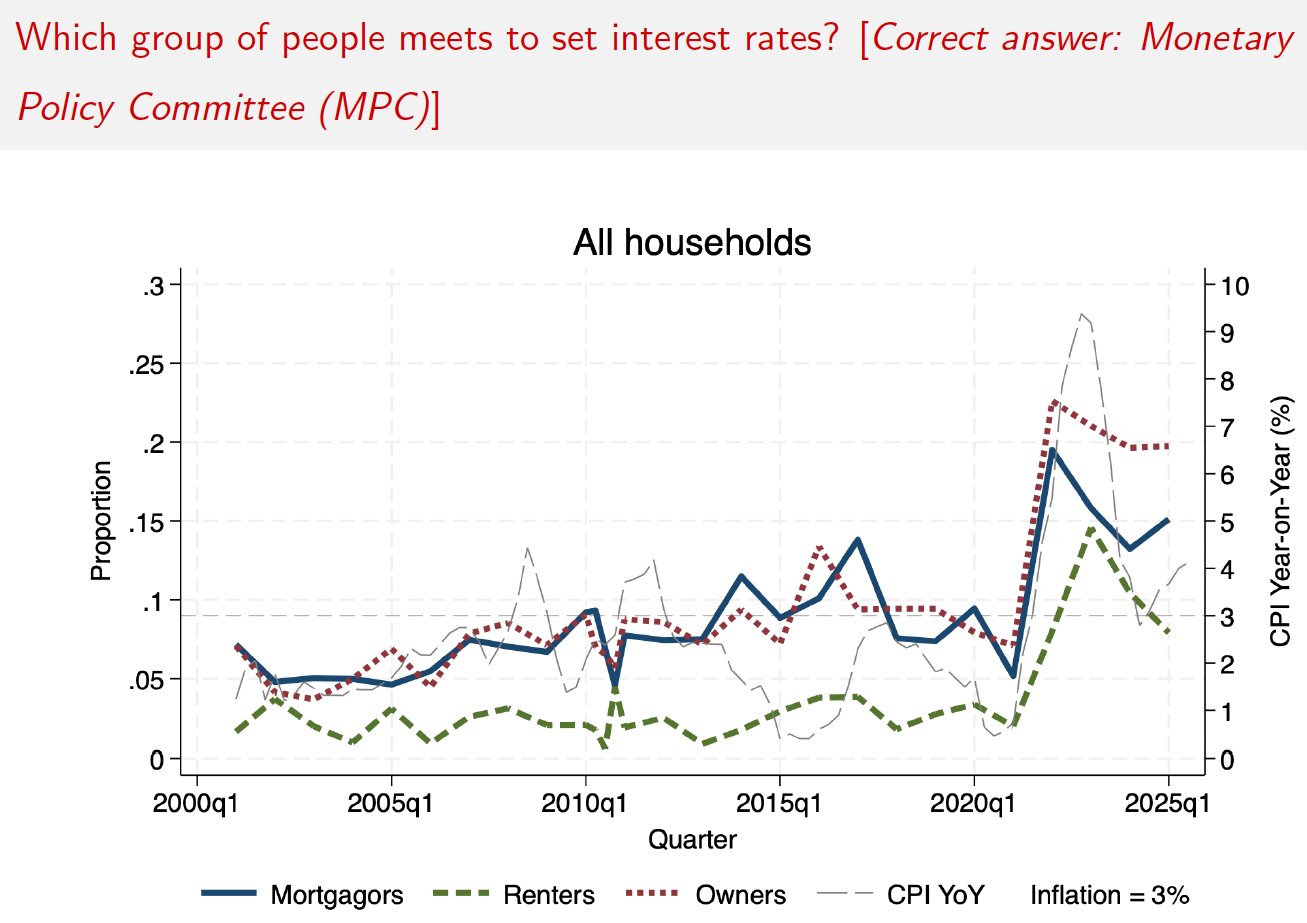
Figure 1.
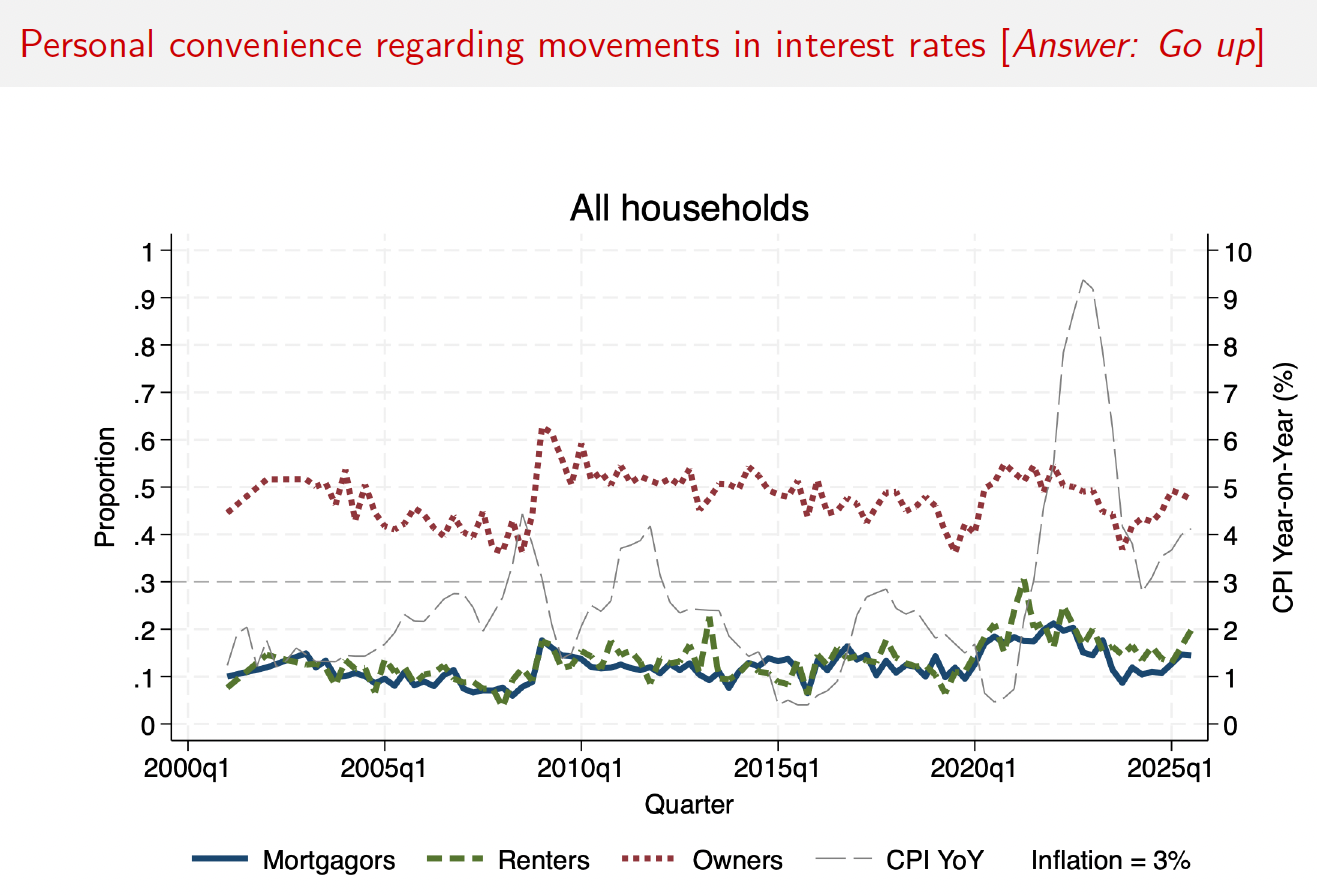
Figure 2.
Finally, it could be interesting to analyze how cultural factors affect attention to inflation. For example, long-term versus short-term orientations, or individualism versus collectivism (potential peer effects), may play a role. Another relevant question is the impact of immigration on households’ attention to inflation.
The United States, Europe, and Latin America have all experienced a significant increase in migration. Many migrants come from countries with very high inflation—if not outright hyperinflation. Individuals from such environments may pay closer attention to changes in purchasing power even after moving to countries with historically stable inflation. This raises important questions regarding the implications for monetary policy, which merit further analysis.
References
Bracha, A., & Tang, J. (2025). Inflation levels and (in) attention. Review of Economic Studies, 92(3), 1564–1594.
Braitsch, H., & Mitchell, J. (2022). A new measure of consumers’ (in) attention to inflation. Federal Reserve Bank of Cleveland, Economic Commentary, 2022-14.
Cloyne, J., Ferreira, C., & Surico, P. (2020). Monetary policy when households have debt: new evidence on the transmission mechanism. The Review of Economic Studies, 87(1), 102–129.
Delgado, C. (2025, August 24). Household inflation expectations: From the brain to the data. LinkedIn.
Korenok, O., Munro, D., & Chen, J. (2026). Inflation and attention thresholds. Review of Economics and Statistics, 1–28.
Maćkowiak, B., Matějka, F., & Wiederholt, M. (2023). Rational inattention: A review. Journal of Economic Literature, 61(1), 226–273.
Malmendier, U., & Wellsjo, A. S. (2024). Rent or buy? inflation experiences and homeownership within and across countries. The Journal of Finance, 79(3), 1977–2023.
Pfäuti, O. (2023). The inflation attention threshold and inflation surges. arXiv preprint arXiv:2308.09480.
Pfäuti, O. (2025). Inflation—who cares? Monetary policy in times of low attention. Journal of Money, Credit and Banking, 57(5), 1211–1239.
Piccolo, J., & Gorodnichenko, Y. (2025). Homeownership and Attention to Inflation: Evidence from Information Treatments. NBER Working Paper No. 33595.
Schultz, J. L. (2021). Inflation Expectations over the Life Cycle under Rational Inattention. Doctoral dissertation, Duke University Durham.
Shabalina, E., & Tzaawa-Krenzler, M. (2025). Heterogeneous attention to inflation and monetary policy. IMFS Working Paper Series, No. 219.
Sims, C. A. (2003). Implications of rational inattention. Journal of Monetary Economics, 50(3), 665–690.
Weber, M., Candia, B., Afrouzi, H., Ropele, T., Lluberas, R., Frache, S., ... & Ponce, J. (2025). Tell Me Something I Don't Already Know: Learning in Low- and High-Inflation Settings. Econometrica, 93(1), 229–264.