
From Central Banks to Households: The Journey of Monetary Policy
Published:
Central banks seek to stabilize inflation by influencing aggregate demand. Movements in interest rates can affect household consumption either directly or indirectly. In this blog, I refer to the process through which changes in interest rates eventually modify consumption as the travel of monetary policy — that is, the transmission process. The famous phrase “All roads lead to Rome” applies here, since monetary policy travels through different channels to affect consumption. The purpose of this blog is to present the main transmission mechanisms, along with empirical evidence and a discussion of potential gaps in the existing literature.
The direct channel of monetary policy transmission is intertemporal substitution. This refers to the extent to which households shift consumption from the present to the future when interest rates rise. In terms of modeling, it is captured by an elasticity (Hall, 1988). There are different views in the literature regarding the value of the elasticity of intertemporal substitution (EIS). Empirical evidence based on subjective expectations suggests an elasticity between 0.5 and 0.7 (Crump et al., 2022). At the same time, another strand of literature finds that wealthier households, stock market participants, and individuals with low risk aversion tend to have a higher EIS (Vissing-Jørgensen and Attanasio, 2003). However, there is also evidence that the EIS is invariant across states of the economy—that is, between expansions and recessions—and across housing tenure categories (Delgado, 2025).
There are also several indirect channels, through which interest rates affect other macroeconomic variables that, in turn, influence consumption. This represents a longer journey from interest rates to households. One example is the income channel: a reduction in interest rates stimulates aggregate demand, which increases households’ income. In response, households allocate a fraction of this additional income to consumption, according to their marginal propensity to consume (MPC).
Another indirect mechanism is the cash-flow, or interest rate exposure, channel, through which payments linked to interest rate changes are affected. For example, if a household is repaying a mortgage, an expansionary monetary policy reduces the outflow of cash from these repayments when the mortgage has an adjustable rate. If the mortgage instead has a fixed rate, monetary easing can increase the incentive to refinance the debt. A third indirect mechanism is the wealth channel, where changes in inflation generated by monetary policy alter the real value of both assets and liabilities. This is also known as the Fisher channel. For instance, if inflation rises after a reduction in interest rates, wealth is redistributed from lenders to borrowers, since the real value of nominal debt decreases. When the effects of these two channels interact—redistributing resources across households with different marginal propensities to consume (MPCs)—there is an additional impact on aggregate consumption. This is referred to as the redistribution channel (Auclert, 2019).
Finally, the liquidity constraints channel posits that households respond differently in their consumption behavior depending on their holdings of financial assets and debt levels. When households are wealthy and possess substantial assets, they can use these as buffers to smooth consumption, making them less sensitive to changes in interest rates. In contrast, households facing liquidity constraints tend to exhibit hand-to-mouth behavior, meaning that an expansionary monetary policy gives them an incentive to take on more debt due to improved credit conditions, thereby enabling them to meet their consumption needs (Cloyne et al., 2020).
When comparing the magnitude of the effects across mechanisms, evidence shows that indirect channels account for about two-thirds of the total impact of monetary policy in Heterogeneous Agent New Keynesian (HANK) models. Consequently, only one-third of the total effect is explained by the direct intertemporal substitution channel (Kaplan et al., 2018); (Alves et al., 2020).
Ampudia et al. (2024) study how household financial choices—specifically participation in stock markets and portfolio rebalancing—shape the impact of monetary policy on consumption. The authors develop a structural discrete choice model that incorporates financial frictions in the form of entry and adjustment costs. By matching model-implied moments to data from four European countries (Spain, Italy, France, and Germany), they generate a distribution of marginal propensities to consume (MPCs) across income, age, and education levels. They also use empirical estimates of the exogenous responses of household income by quintile and of stock prices to an expansionary monetary policy shock, in order to analyze the income and return channels, as well as their distributional effects. The return channel operates when a reduction in interest rates increases stock returns through a lower discount factor applied to future dividends, which raises stock prices, and through improved investment opportunities. Stockholders may then allocate a portion of this marginal increase in wealth to consumption.
Their main finding is that the intensity of the consumption response to monetary policy is country-specific. The results indicate that the response in France is the smallest, whereas that in Italy is the largest. The authors conduct a counterfactual exercise in which they replace the parameters estimated for France with those of Italy. Italian households display a higher level of patience (higher discount factor, β), a lower risk aversion coefficient (γ), and a higher elasticity of intertemporal substitution (θ), regardless of education level. Figure 8 in their paper reports the change in the consumption response under this parameter substitution. The impact of monetary policy on consumption in France indeed increases with the Italian parameters; however, it remains below the original response observed for Italy. When the authors further add Italy’s exogenous responses of household income and stock prices—which represent the indirect channels—to the French parametrization, the response becomes larger and more persistent. This implies that a significant portion of the cross-country differences in the effects of monetary policy remains unexplained.
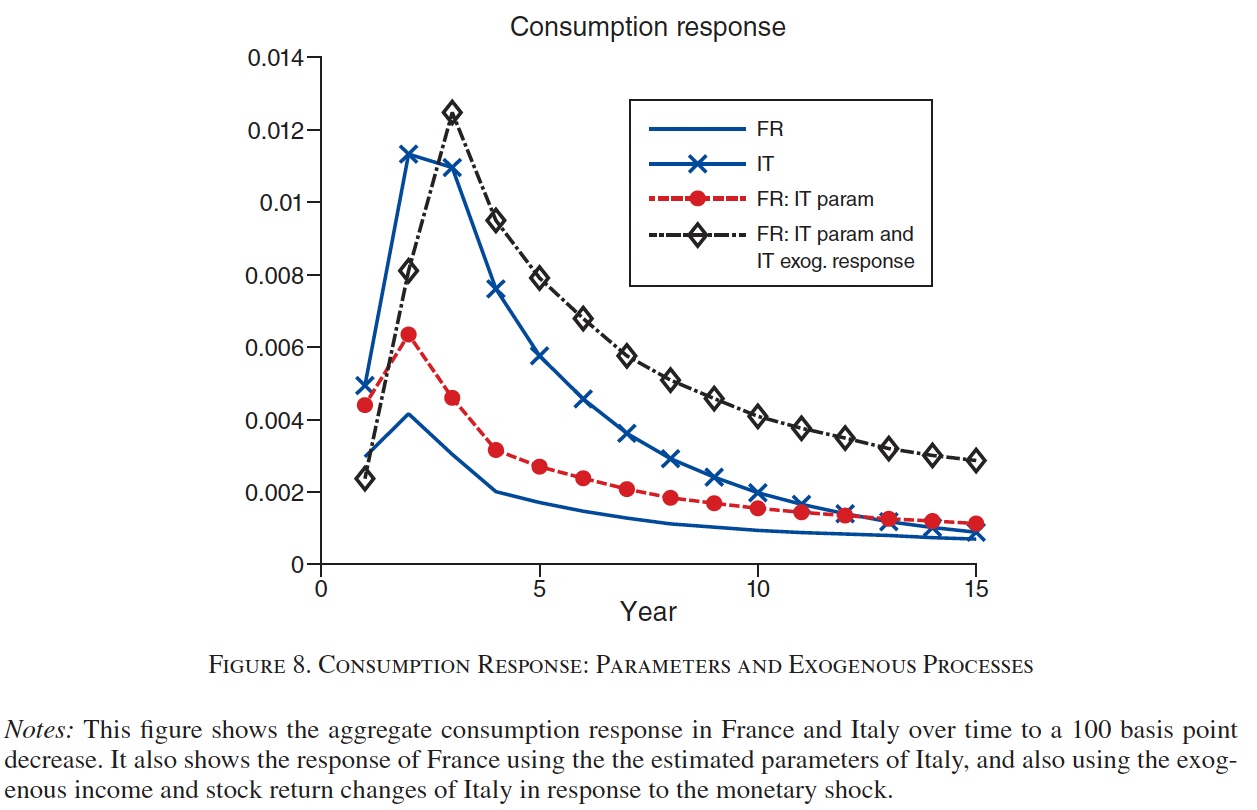
Figure 8. Consumption response: Parameters and Exogenous Processes.
Finally, when examining the relationship between household income and the impact of monetary policy, they find a negative relationship for Spain and Italy, while France and Germany exhibit a U-shaped pattern. The income channel tends to be stronger for low-income households, who have higher marginal propensities to consume (MPCs), whereas the return channel mainly stimulates consumption among high-income households, who are more likely to participate in stock markets.
As mentioned earlier, part of the cross-country differences in the impact of monetary policy among these four countries cannot be explained by variations in the parametrization process. Therefore, it would be interesting to explore whether similar patterns of results between Spain and Italy, and between Germany and France, also appear in other dimensions. One possible explanation involves cultural factors, which are associated with the set of social norms and values that shape behavior within a society. The Culture Factor Group is an organization that collects data on individuals’ attitudes across six dimensions: power distance, individualism, motivation toward achievement and success, long-term orientation, and indulgence (The Culture Factor Group, n.d.). The following set of graphs presents the levels of these factors for the four countries.
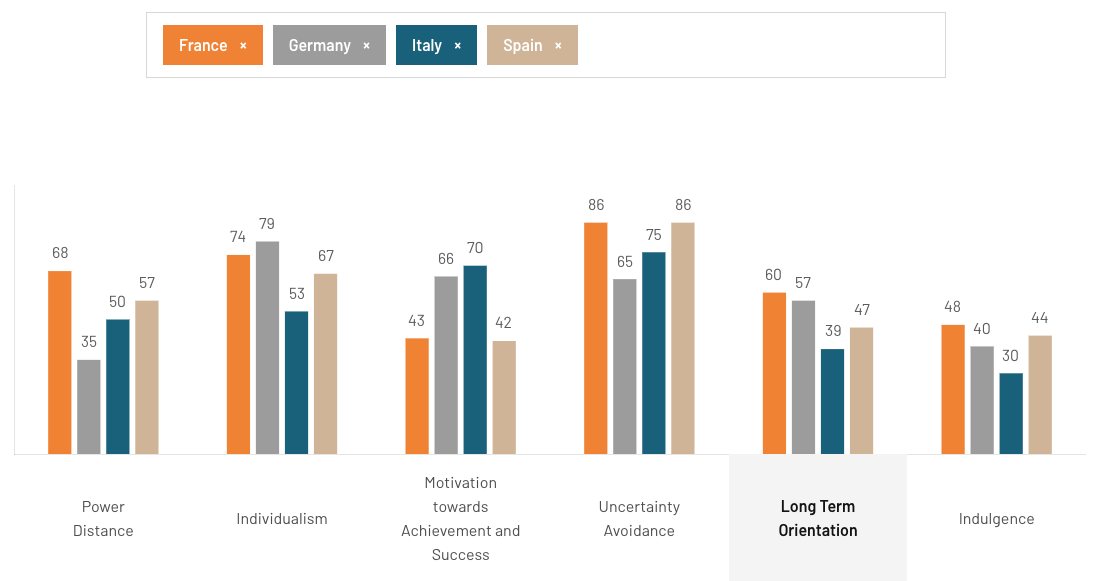
It is observed that both Germany and France exhibit relatively higher levels of individualism compared with Italy and the European average. My hypothesis is that more collectivist societies experience stronger spillover effects in the transmission of monetary policy, as closer social ties may enhance communication and information sharing. Consequently, monetary policy transmission could be stronger in these contexts. At the same time, less individualistic societies may display higher marginal propensities to consume (MPCs), as part of their consumption may involve caring for others within their social networks. These societies might also feature higher consumption floors, supported by government transfers and social safety nets.
Regarding long-term orientation, a similar pattern emerges, with Germany and France again exhibiting higher levels in this dimension. This cultural factor may be associated with a lower prevalence of hand-to-mouth (HtM) behavior among households. Such an explanation could account for why the effects of monetary policy are stronger in Spain and Italy, particularly among low-income households.
Institutional quality may also influence the intensity of the impact of monetary policy on households’ consumption. Evidence shows that institutional quality—encompassing aspects such as law and order, government stability, and the investment profile—is significantly related to the cyclicality of monetary policy. In other words, under high institutional quality, demand shocks generate a positive comovement between output and interest rates, whereas under low institutional quality, this comovement becomes negative (Duncan, 2014). Furthermore, in countries with weak institutional quality, medium-term growth risks tend to rise following contractionary monetary policy shocks, while these risks remain relatively stable in countries with strong institutional frameworks (Emter et al., 2024).
I collect data from the World Bank and the International Monetary Fund (IMF) on institutional quality and financial market development, respectively, for the countries analyzed by Ampudia et al. (2024), in order to identify patterns that could explain the nonlinear impact of monetary policy. The data are presented in the table below.
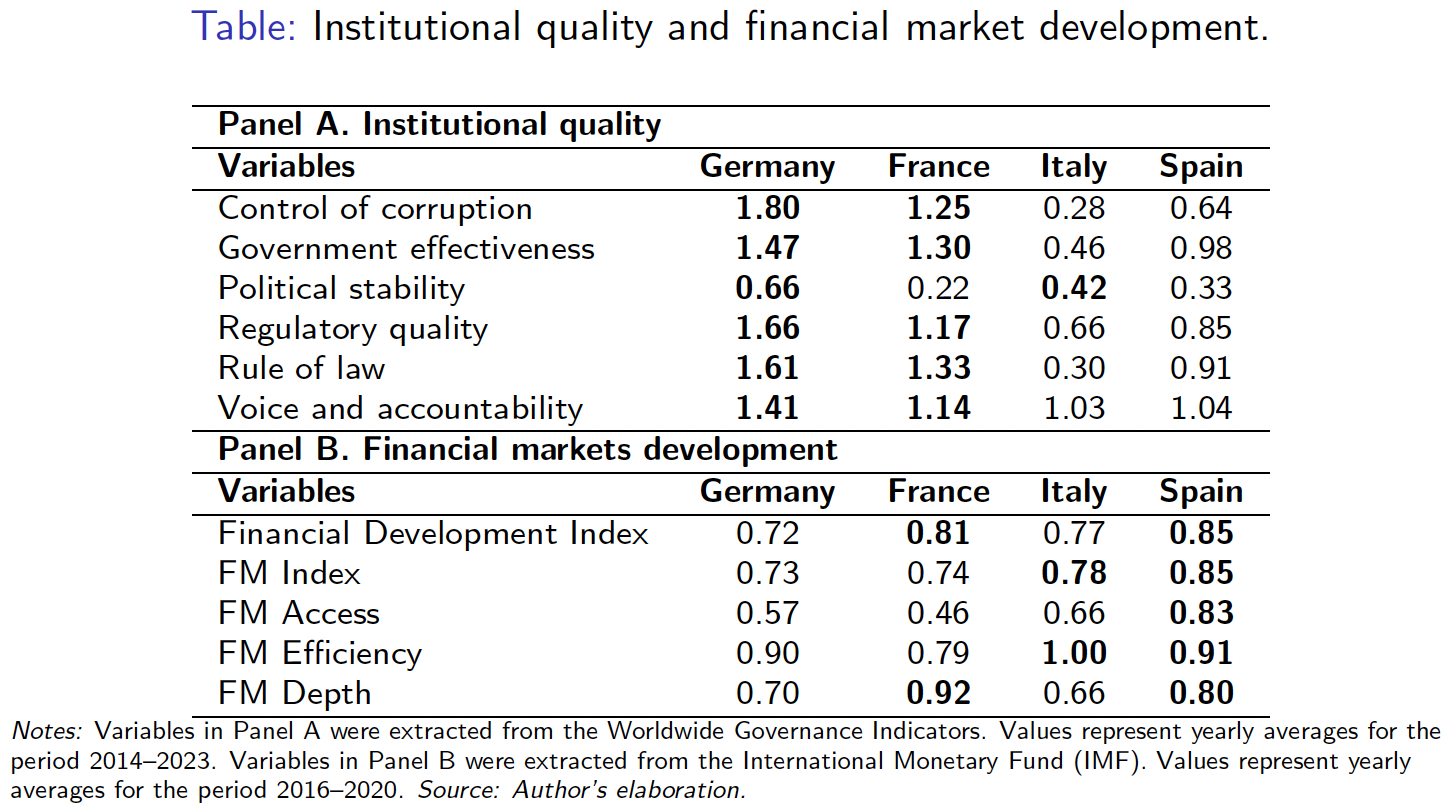
In Panel A, the values of institutional quality are higher for Germany and France, which are the countries that exhibit a lower impact of monetary policy. Following the evidence presented by Emter et al. (2024), high institutional quality may smooth the transmission of monetary policy, thereby enhancing economic resilience. In addition, Panel B shows that Spain has the most developed financial markets, particularly in terms of access, efficiency, and depth. According to the findings of Ampudia et al. (2024), Spain exhibits the strongest and fastest response in the return channel. Consequently, the high level of stock market development may help explain this result.
In conclusion, there are still many challenges in uncovering new routes in the travel of monetary policy from central banks to households. The current research trend points toward understanding its heterogeneous and distributional effects. I believe that behavioral channels represent an important avenue for further exploration. For instance, not all households pay the same level of attention to inflation or changes in interest rates. Moreover, greater efforts could be devoted to modeling and testing the impact of cultural differences on monetary policy transmission.
References
Alves, F., Kaplan, G., Moll, B., & Violante, G. L. (2020). A further look at the propagation of monetary policy shocks in HANK. Journal of Money, Credit and Banking, 52(S2), 521–559.
Ampudia, M., Cooper, R., Le Blanc, J., & Zhu, G. (2024). MPC heterogeneity and the dynamic response of consumption to monetary policy. American Economic Journal: Macroeconomics, 16(3), 343–388.
Auclert, A. (2019). Monetary policy and the redistribution channel. American Economic Review, 109(6), 2333–2367.
Cloyne, J., Ferreira, C., & Surico, P. (2020). Monetary policy when households have debt: new evidence on the transmission mechanism. The Review of Economic Studies, 87(1), 102–129.
Crump, R. K., Eusepi, S., Tambalotti, A., & Topa, G. (2022). Subjective intertemporal substitution. Journal of Monetary Economics, 126, 118–133.
Delgado, C. (2025). Monetary Policy During Good and Bad Times: The Role of Household Debt and Liquidity. Available at SSRN 5465255.
Duncan, R. (2014). Institutional quality, the cyclicality of monetary policy and macroeconomic volatility. Journal of Macroeconomics, 39, 113–155.
Emter, L., Moura, A., Setzer, R., & Zorell, N. (2024). Monetary policy and growth-at-risk: the role of institutional quality. European Central Bank (ECB) Working Paper No. 2024/2989.
Hall, R. E. (1988). Intertemporal substitution in consumption. Journal of Political Economy, 96(2), 339–357.
Kaplan, G., Moll, B., & Violante, G. L. (2018). Monetary policy according to HANK. American Economic Review, 108(3), 697–743.
The Culture Factor Group. (n.d.). Country comparison tool. Retrieved October 30, 2025.
Vissing-Jørgensen, A., & Attanasio, O. P. (2003). Stock-market participation, intertemporal substitution, and risk-aversion. American Economic Review, 93(2), 383–391.