
Uncertainty, Risk and Ambiguity: What Is the Difference?
Published:
Uncertainty is one of the most extensively studied concepts in economics. Providing a formal definition is not straightforward, as it can be analyzed from various contexts and perspectives. Before delving into the concept itself, I will first introduce several related terms that are commonly associated with uncertainty.
When we think about uncertainty, we often associate it with risk. Economic agents face decision-making processes in environments where the value of future outcomes is unknown. For simplicity, we can consider a lottery choice in which an individual knows the existence of two sets of payoffs, each associated with a specific probability of occurrence.
In a more realistic setting—such as a firm deciding whether to invest in a new project—we can simplify the analysis by considering three potential scenarios: optimistic, normal, and pessimistic. For each scenario, the firm would face a different net present value outcome, and each scenario could materialize with a certain probability.
Given the previous set of possibilities, we can define an expected outcome using standard statistical concepts. We can also calculate the standard deviation of the outcomes, which captures the dispersion around the expected value. This is known as risk—particularly when the standard deviation is considered relative to the expected outcome for comparison purposes.
The greater the dispersion of outcomes across scenarios, the higher the level of risk. Finally, we can define individual preferences over lotteries. In simple terms, when agents prefer a lottery with lower risk over a riskier one—both having the same expected value—they are said to be risk-averse.
So, what is uncertainty? Or, more precisely, what is the difference between risk and uncertainty? The literature presents different approaches to this question; here, I aim to introduce one of them. Sometimes, people may treat risk and uncertainty as synonymous—but this is not accurate. Risk refers to situations where the outcome is unknown, but the probability distribution over possible states of nature is known or can be reasonably assumed. In contrast, uncertainty involves both a lack of knowledge about the outcome and about the probability distribution itself.
The second piece of this conceptual puzzle is known as ambiguity. In my view, we can think of risk as a lower bound when discussing uncertainty in real-world settings.
For example, the COVID-19 pandemic was one of many possible states of nature that the world encountered at the beginning of the current decade. It clearly affected the value of many economic outcomes, including GDP growth, unemployment, and inflation. However, before news of the virus emerged, the possibility of facing a global pandemic was ambiguous, due to the lack of knowledge about the true probability of such an event. A pandemic of this magnitude may not have even been considered a plausible state of nature by most forecasters.
In terms of individual preferences, ambiguity aversion is defined as the tendency to prefer lotteries with clearly defined probabilities for each state of nature over options with vague or undefined probabilities, given the same set of potential outcomes (Trautmann et al., 2008).
Uncertainty is not a directly observable variable, so scientists—including economists—have developed various methodologies to measure it (Cascaldi-Garcia et al., 2023). From a macroeconomic perspective, there are several ways to quantify uncertainty. Two of the most well-known metrics are the Chicago Board Options Exchange (CBOE) Volatility Index (VIX) and the Economic Policy Uncertainty (EPU) Index. The former captures investors’ expectations of future stock market volatility (Kalyani, 2025), while the latter is based on the frequency of newspaper coverage of related events (Baker et al., 2016).
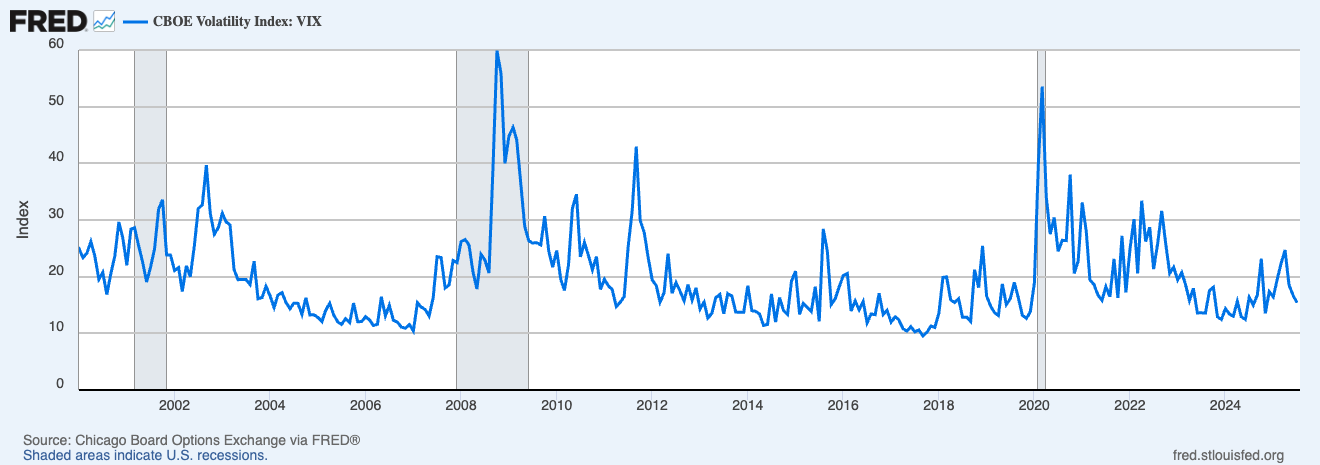
Figure 1. CBOE Volatility Index (VIX). Source: Chicago Board Options Exchange via FRED.
When examining trends in the VIX, the index tends to be countercyclical, with its highest peaks occurring during major economic crises—such as the Great Recession and the COVID-19 Recession. In contrast, the EPU Index has shown an upward trend since 2007. Although it experiences spikes during crises, its value does not return to pre-crisis levels during economic expansions; instead, it exhibits a persistently positive trend over time.
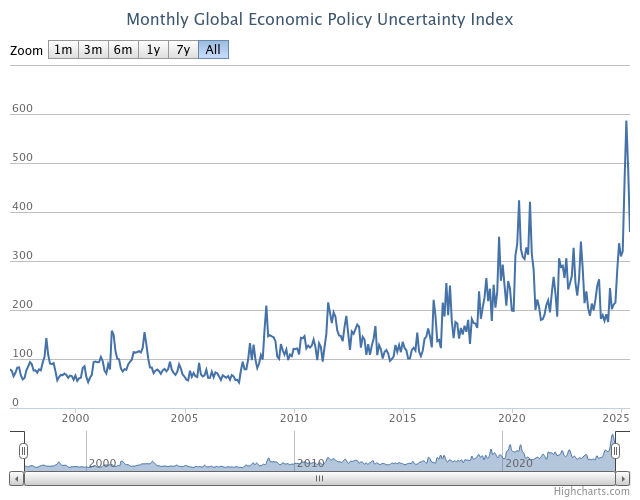
Figure 2. Monthly Global Economic Policy Uncertainty Index.
Bouteska et al. (2024) find that the VIX and the EPU index capture uncertainty from different dimensions. The former reflects risk aversion, while the latter captures ambiguity aversion. When comparing these measures, there has been a sustained increase in ambiguity levels over time.
From a macroeconomic perspective, de Souza (2022) identifies both risk and ambiguity shocks in inflation expectations using survey data from Brazil. The author applies the Expected Utility with Uncertain Probabilities (EUUP) framework (Izhakian, 2020) to elicit these shocks.
When analyzing their effects on macroeconomic outcomes, both types of shocks negatively affect the economic cycle. However, ambiguity shocks have a stronger impact than risk shocks. These findings have important implications for policymakers’ ability to anchor expectations and for the effectiveness of forward guidance.
Therefore, I believe that to advance the study of decision-making under uncertainty, the traditional approach based solely on expected return and risk is incomplete. We need to incorporate an additional dimension of uncertainty—namely, ambiguity.
References
Baker, S. R., Bloom, N., & Davis, S. J. (2016). Measuring economic policy uncertainty. The Quarterly Journal of Economics, 131(4), 1593–1636.
Bouteska, A., Sharif, T., Hajek, P., & Abedin, M. Z. (2024). Aversion and ambiguity: On the robustness of the macroeconomic uncertainty measure framework. Technological Forecasting and Social Change, 203, 123340.
Cascaldi-Garcia, D., Sarisoy, C., Londono, J. M., Sun, B., Datta, D. D., Ferreira, T., ... & Rogers, J. (2023). What is certain about uncertainty? Journal of Economic Literature, 61(2), 624–654.
de Souza, M. C. (2022). Modeling ambiguity and risk in inflation expectations: Empirical analysis for Brazil. Applied Economics, 54(56), 6521–6535.
Izhakian, Y. (2020). A theoretical foundation of ambiguity measurement. Journal of Economic Theory, 187, 105001.
Kalyani, A. (2025). Measuring fear: What the VIX reveals about market uncertainty. FRED Blog, Federal Reserve Bank of St. Louis.
Trautmann, S. T., Vieider, F. M., & Wakker, P. P. (2008). Causes of ambiguity aversion: Known versus unknown preferences. Journal of Risk and Uncertainty, 36(3), 225–243.